Classic cars demand a different approach to storage because age, materials, and limited replacement parts can make environmental exposure especially costly. Sunlight, moisture, hail, dust, and temperature swings may gradually affect paint, rubber seals, upholstery, and metal components. For owners who lack a permanent enclosed building, a portable garage can provide covered space while preserving flexibility. SUNJOY’s outdoor structures offer useful examples of how substantial exterior protection can also serve broader property needs.
Protecting Classic Cars From Weather Exposure
Direct sunlight can be a gradual source of damage to an older vehicle. Ultraviolet exposure can gradually fade paint and deteriorate plastics, dashboards, weather stripping, and interior fabrics. Covered storage reduces direct sunlight and ultraviolet exposure to these surfaces between drives.
Rain creates another concern, particularly when moisture reaches seams, underbody components, or areas where corrosion has already begun. Keeping the vehicle under a roof reduces direct precipitation, although ventilation remains important because trapped humidity can create its own problems.
Hail and falling debris present more immediate physical risks. Tree branches, heavy precipitation, and seasonal storms can damage vulnerable body panels even when a vehicle is parked for only a short period. A roof can reduce the vehicle’s direct exposure to hail, precipitation, and some falling debris, although an open-sided structure does not provide the same protection as an enclosed garage.
Controlling Temperature And Humidity
Temperature changes affect more than cabin comfort. Rubber components can expand and contract with repeated thermal cycles, while condensation may form when warm, humid air encounters cooler metal surfaces. Good storage therefore combines weather protection with appropriate ventilation and moisture control.
Ventilation helps moisture escape from the covered area. Completely sealing a vehicle inside an unventilated enclosure may allow humidity to accumulate, especially after rain or washing. Open-sided structures can provide a useful balance between precipitation protection and natural air movement.
Ground conditions should not be overlooked. Water pooling beneath the vehicle can increase humidity around tires, suspension components, and underbody surfaces. Choosing a location with suitable drainage makes the storage environment more manageable and supports long-term vehicle care.
Choosing The Right Structure For Vehicle Storage
Vehicle dimensions should guide the size decision. Length and width need to accommodate not only the car but also enough room to open doors, walk around the vehicle, and perform basic maintenance. Clearance becomes particularly important with wider classic models or vehicles equipped with trailers and accessories.
Permanent garages offer enclosed protection but may require substantial construction work, permits, and a fixed allocation of property space. A carport provides another approach, giving vehicles a roof and open access while generally requiring less enclosed infrastructure.
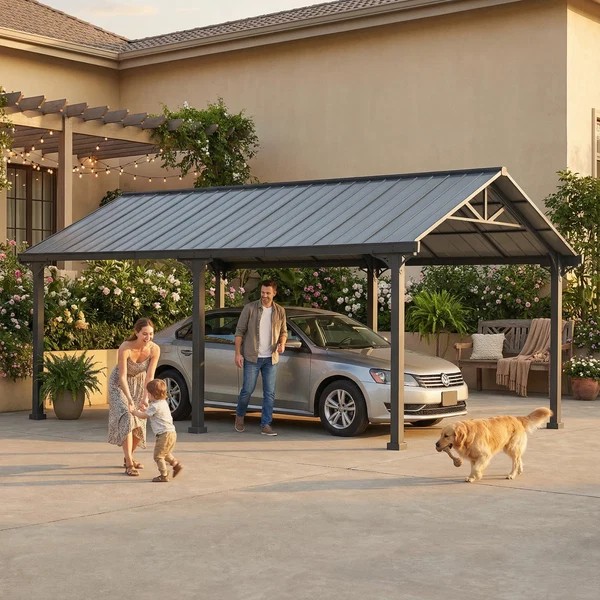
The Armored Gable-Roof Steel Carport, 12×20 offers an example of a larger covered footprint. Its listed 12 × 20 ft. size is designed for vehicles, boats, or trailers, while the structure uses a rust-resistant galvanized steel frame and a gable roof. The product information also describes its suitability for harsh outdoor conditions including strong sun, hail, heavy rain, and winter snow.
Creating A Better Storage Environment
A roof alone does not resolve every storage concern. Dust can still enter from the sides, while leaves and airborne debris may settle on the vehicle. A breathable automotive cover can provide another layer of protection, provided it is appropriate for the vehicle and storage environment.
Security also deserves attention. Open structures offer convenient access but provide less physical separation than an enclosed building. Motion lighting, cameras, vehicle security devices, or positioning the structure within a visible part of the property may improve overall security without changing the basic design.
Maintenance remains necessary even under cover. Tire pressure, battery condition, fluid levels, seals, and signs of moisture should be checked according to the vehicle manufacturer’s recommendations. Periodic inspection allows small problems to be identified before they develop into expensive restoration work.
Balancing Flexibility With Long-Term Protection
Property needs can change over time. Someone may eventually build a permanent garage, acquire another vehicle, or repurpose part of the yard. Flexible covered storage can accommodate those changes more easily than construction that permanently occupies the same footprint.
A portable garage can also be useful for owners who move between properties or rent their homes, although portability depends heavily on the particular structure and installation method. Product specifications should be reviewed carefully rather than assuming every covered vehicle structure can simply be relocated.
Classic cars benefit from consistency more than occasional protection. Keeping exposure to sun, precipitation, debris, and temperature extremes under control can support preservation efforts between maintenance sessions. The right storage arrangement should therefore match the vehicle’s dimensions, local climate, available space, and owner’s maintenance routine.
Conclusion
Preserving a classic vehicle involves more than preventing obvious physical damage. Environmental exposure, humidity, drainage, airflow, security, and available maintenance space all shape the storage environment. Selecting suitable covered protection can reduce unnecessary weather exposure while keeping the property adaptable. For owners comparing carport solutions, the appropriate design depends on the vehicle and site rather than a single universal specification. SUNJOY‘s Armored Gable-Roof Steel Carport provides one example of how a 12 × 20 ft. covered footprint and galvanized steel construction can be considered when evaluating vehicle storage options.